



Every ServiceNow freelancer knows the feeling: you land a mission that seems perfect. The project is strategic, the clients are collaborative, and a sense of mutual trust makes everything feel like it’s going to run smoothly. For the most part, it does.
But sometimes, things go wrong.
The tone shifts, not with a sudden bang, but through a series of weak signals and unilateral decisions made far from the project’s front lines. A promising engagement can quickly devolve into a stressful, high-stakes dispute.
This post shares the true story of a ServiceNow freelancer from the N2 Help & Solutions community who faced this exact situation. It’s a real-world case study in how to navigate a contractual conflict, with names changed to protect confidentiality. These are the hard-won lessons that can help you protect your business, your rights, and your peace of mind.
A contract isn’t a formality, it’s your protection
It’s easy to treat a contract as a simple administrative step, especially when the initial interactions with a client are positive and encouraging. We often focus on the exciting work ahead and skim the legal boilerplate, assuming good faith will carry the day.
The freelancer in this story, however, quickly identified serious imbalances in the contract he received. These weren’t minor typos; they were fundamental issues, including a disproportionate non-compete clause, a one-sided confidentiality agreement, and a glaring absence of any clause for prior mediation in case of a dispute. In total, he flagged seventeen unbalanced points that put him at a significant disadvantage. This early diligence was the first and most critical step in defending his position.
Based on his experience, here is some actionable advice for reviewing any freelance contract:
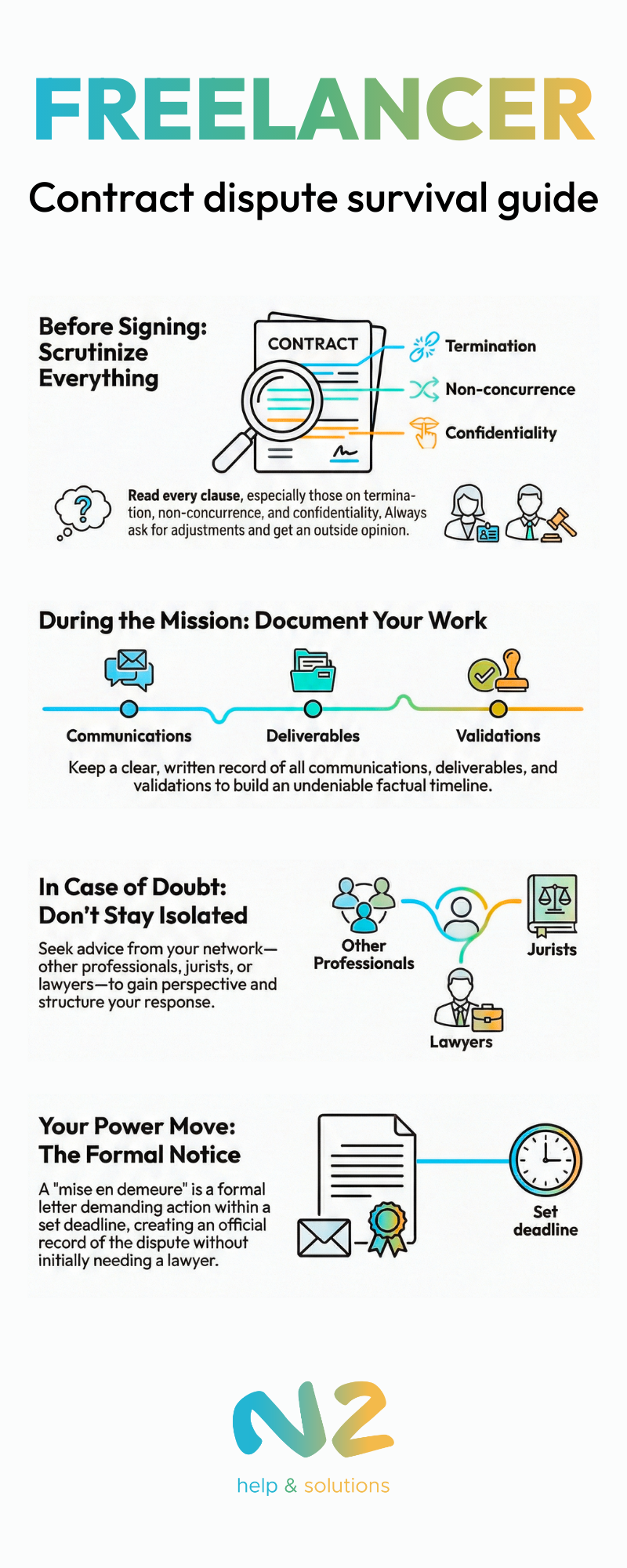
- Read every single clause, especially those on termination, non-compete, and confidentiality.
- Insist on realistic notice periods that match the project’s duration and complexity.
- Don’t be afraid to request adjustments; a contract is a negotiation, not a decree.
- Always get a second opinion from a trusted peer, mentor, or legal expert.
“When you get caught up in a project that seems to be off to a good start, it’s easy to forget that a contract isn’t just a formality: it’s a form of protection. And while trust is invaluable, it should never replace prudence.”
The formal notice of default
When communication breaks down and a client refuses to address serious contract issues, freelancers can feel powerless. But there is a powerful, structured step you can take that doesn’t necessarily require hiring a lawyer: issuing a formal notice of default.
This is a formal letter that officializes your complaint and demands action. Contrary to popular belief, you can write and send one yourself. It simply needs to contain three key elements:
- A clear statement of what the other party has done wrong (e.g., failed to provide a balanced and corrected contract).
- A clear demand for a specific action or correction.
- A reasonable deadline for them to comply (typically 8 to 15 days).
The author’s professionalism was met with intransigence. After sending a detailed email on June 25th requesting changes, he received a clear refusal from the client’s president on June 30th. Wasting no time, he acted on his prior warning: on July 1st, he sent a formal notice by registered mail to officially suspend his services until the contract was corrected. This single, methodical step transformed a stalled email chain into an official dispute, forcing a high-level meeting within 48 hours.
Listen to the weak signals before they become a crisis
Major disputes rarely appear out of thin air. They are almost always preceded by subtle changes in behavior and communication.
As the mission progressed, the author began noticing several of these signals. Key contacts who were once readily available suddenly had less time. The frequency of direct, collaborative exchanges diminished. The final warning sign was a sudden change in the project’s direction, announced without any prior discussion or explanation.
Paying attention to these shifts is crucial.
They are your early warning system. Noticing them allows you to become proactive instead of reactive. You can start documenting exchanges more meticulously, ask clarifying questions to get things in writing, and mentally prepare for potential issues before being caught completely off guard.
Never accept a verbal promise over a written clause
During a tense negotiation, a client may resort to a high-pressure tactic: asking you to sign a flawed contract now with the verbal promise of fixing it later with an amendment.
This is exactly what happened during the contract review meeting.
The client’s president, “Vector” repeatedly tried to get the author to sign the existing, unbalanced contract, assuring him they could sort out the details in a future amendment.
The author’s response was simple and unwavering: he refused.
He calmly but firmly insisted that all agreed-upon changes be integrated into the contract before he would sign it. When the client attempted to evade certain points, he actively steered the conversation back to the essential task of correcting the contract.
This was a critical moment.
A verbal promise is not contractually binding, and had he given in, he would have lost all leverage. His refusal to accept words over written clauses was essential to protecting his interests.
Your strongest asset is your network
Facing a client dispute can be an incredibly isolating experience. It’s easy to feel like it’s you against the world, which can lead to self-doubt and costly mistakes.
This freelancer immediately understood the power of community.
Before formally responding to the client, he consulted with his network, including friends who were company directors, senior managers, lawyers, and legal experts. Their objective feedback was crucial; it helped him move beyond a subjective ‘gut feeling’ and objectify the contract’s imbalances, turning his concerns into a structured, defensible position.
Furthermore, he included representatives from N2 Help & Solutions in all his communications with the client.
Although N2 had no contractual link to the client, they acted as crucial mediators, helping to clarify roles, lower tensions, and provide moral support. This story is a powerful testament to the directive’s core message: you are not alone. When you face challenges, lean on your professional community for advice, perspective, and support.
Be attentive, not paranoid
The goal of sharing this experience isn’t to make freelancers cynical or to suggest that every client relationship is a potential battle. It is to arm you with awareness and empower you with prudence.
Being a successful independent professional requires balancing trust with vigilance. You can and should build positive, collaborative relationships with clients, but that should never come at the expense of protecting yourself with a fair and balanced contract.
“This is not about becoming suspicious, but about becoming attentive.”
As you move forward, remember the lessons from this real-world story:
What is one small step you can take today to check that your current contracts truly protect you?
Whether it’s seeking a second opinion, clarifying a vague clause, or simply rereading an old agreement, taking proactive steps is always the right move.
And remember, communities like N2 Help & Solutions exist to foster a culture of prevention over cure, providing the support and guidance you need for exactly these situations.